Showing posts with label Hardware. Show all posts

Wednesday, April 16, 2014

MSI AM1I: socket AM1 in Mini ITX


After Asus motherboard and AM1I-A , it's time to make a MSI mother AM1 card Mini ITX format: the AM1I.

Aimed at Kabini processors on socket AM1 (ie all new Sempron and Athlon AMD), the AM1I has two DDR3 connectors (for up to 16GB of memory DDR3-1333/1600), two SATA 6Gbps ports, a miniPCIe connector and a PCI-Express 2.0 x16. There are also audio and Gigabit Ethernet controllers, USB 2.0 and 3.0 ports or VGA, DVI and HDMI 1.4a outputs. PS / 2 connectors are even present.


The only regret is that MSI has not yet indicated price or availability date for this new motherboard. As a reminder, the Asus AM1I-A is displayed at a rate of only 34 euros

Sunday, August 19, 2012

WHQL 305.68 Nvidia drivers to support the GeForce GTX 660 Ti

Nvidia on Thursday released a new version of drivers for its graphics cards, to accompany the launch of the GeForce GTX 660 Ti. For now, however they are deadlocked on Windows 8 RTM.

 The first buyers of the GeForce GTX 660 Ti launched Thursday by Nvidia can turn to 305.68 WHQL drivers, officially for the management of this new graphics card.  Now available for download, however they are limited to Windows XP, Vista or Windows 7: the U.S. does in fact not so far from unified version that would also take the public test version of Windows 8 RTM.


 The other GPU family are in turn affected by the latest stable release dated GeForce drivers, the 301.42 WHQL.  There is however little doubt that Nvidia will be keen to quickly consolidate his pilots around what will probably become the branch R305.

Friday, June 25, 2010

MSI Announces cards Twin Froz II GTX 465 and GTX 470

Presented earlier this month at Computex in Taiwan, the raw MSI graphics cards based on the custom GF100 were announced. Known as Twin Froz N470GTX II, Twin II Froz N465GTX and N465GTX Twin Froz II Golden Edition, they are not yet available for all.

Besides its components called "military-grade, which are becoming a habit with MSI, all three cards use the new cooling solution of the Twin Froz II, which contains two 80mm fans and five pipe heat conduction (the Golden Edition is a construction made entirely of copper), capable of reducing the GPU temperature of 16 ° C in full use.

The model includes 448 N470GTX CUDA cores, a 320-bit memory interface, and displays a frequency of 607MHz GPU, 1215MHz for shaders cons, and 1650 MHz to 1280 MB of memory. For N465GTX, the specifications are slightly lower. It has 352 cores, 256-bit interface, and frequency of GPU, shader and memory (1 GB) 607, 1215 and 1600MHz.

Saturday, June 19, 2010

CNR-DVDRW1 : Pocket DVD-drive

What is important in an external optical drive for a miniature laptop? Course size. The actuator must be compact and fit easily into a small bag, laptop, or even a pocket. Canyon CNR-DVDRW1 with this task easily cope, because its dimensions are 134h20h140 mm, weight - 320 grams. Well, to please almost all owners of laptops, the company has released a novelty Canyon in black and white buildings.

With a laptop drive CNR-DVDRW1 connects via USB-cable. On the same cable unit is receiving power. But sometimes it happens that the laptop battery is minimal and another user just "kill" her. In this case supplied with the CNR-DVDRW1 includes the usual network adapter.


Note that delivery Canyon CNR-DVDRW1 also includes software NERO Burning Rom. But the drive itself is compatible with any operating system and supports the "hot" connection. In the new stores have already appeared.

Buffalo Announces Blu-ray drive 12x USB 3.0

Buffalo, which celebrated its third anniversary Thursday of presence on the French market, has confirmed the upcoming release by him of a Blu-ray player using an external USB 3.0. It will display according to the manufacturer the following performance: 12x burning Blu-ray single or dual layer 2x for Blu-ray Disc Rewritable, 16x for DVD and 8x double-layer DVDs.

Although USB 3.0 is still far from being democratic, the Japanese seem to have taken the party to make its next workhorse for external storage devices and promises that all its product lines will soon be ported to the new interface . However, he does not expect the USB 3.0 knows a real takeoff in 2010, partly due to the lack of support in the Intel and AMD.

Joined in the range MediaStation this Blu-ray external will be launched in France during the summer, at a price that would turn around 300 Euros. He will be joined 3D Blu-ray Ready CyberLink Media Suite, which offers support for Blu-ray and 3D upgrade from 2D content to display in relief.

Friday, June 18, 2010

EVGA GeForce GTX 480 launches Superclocked +

EVGA has announced a new benchmark within its range Superclocked which, as its name implies, includes graphics cards whose frequencies of operation have been revised upwards compared to standard models. Latest, the GeForce GTX 480 Superclocked +, which adopts an air cooling device intended to achieve an operating temperature of 7 degrees below that offers the heatsink developed by NVIDIA, despite the overclocking factory applied .

The GeForce GTX 480 Superclocked + EVGA displays and operating frequencies of 726 MHz order for the GPU (700 MHz standard), 1,451 MHz for the shaders (cons 1400 MHz), and 1900 MHz for the 1.5 GB GDDR5 memory integrated (instead of 1850 MHz). Overclocking a relatively modest (around 3%) but would be without fear of overheating by EVGA. The secret lies in the placing of a plaque on the rear of the PCB of the card, as well as the use of a bracket that is slightly larger than what is usual practice. The heat would be removed more easily.


Lifetime warranty, the GeForce GTX 480 Superclocked + is advertised at a price of 529.99 U.S. dollars.

Problems of supply for the Phenom II X6?

AMD encounter some difficulties in recent weeks to meet demand on its first hexa-core processors, the Phenom II X6, to the chagrin of motherboard manufacturers whose products are compatible with these chips struggled to find buyers.

It must be said that with its Phenom II X6 - codenamed Thuban - AMD has been able to offer a more attractive alternative to the single reference to six cores of Intel's catalog. While the Core i7 980X appears prohibitive tariffs ( 950 euros ), both models AMD are sold at prices much more reasonable 180 euros for the Phenom II X6 1055T and 260 euros for the Phenom II X6 BE 1090T .


Due to a price / performance ratio of the most honorable, the Phenom II X6 would thus created a demand greater than what had expected AMD, resulting from a few difficulties in the supply, but also the delay of Phenom II X4 960T. Two news, according to Digitimes, would not really taste the motherboard manufacturers: After struggling to put his hand on the 800 series chipsets, they are currently struggling to sell their models AM3.

Friday, June 11, 2010

Lite-On launches 12x Blu-ray in Europe

Lite-On has confirmed the imminent launch in Europe iHBS212, its first Blu-ray player displaying a maximum write speed of 12x for the next generation optical media.

Moved to 5.25 inches, this internal drive uses a SATA interface, LightScribe technology embeds and displays the following performance thus write:

- 12x for single layer Blu-ray
- 8x for dual layer Blu-ray
- 2x for Blu-ray Disc Rewritable.

Unsurprisingly, the iHBS212 also provides burning DVDs with performances by the order of 16x for DVD-R's, 12x DVD-RAM, 8x double-layer DVDs and 6x DVD-RW.

Lite-On announced a suggested retail price of 165 euros for the box version with Cyberlink software, against 149 euros for the bulk version (iHBS112 reference), in line with the current offer on Blu-ray drives .

Friday, June 4, 2010

AMD is the first demonstration of its APU, Fusion

At Computex, AMD is the first time demonstrated a chip Fusion, which he said must embody the future of personal computing by combining CPU and GPU into a single unit, the APU for Accelerated Processing Unit. On this occasion, the manufacturer has confirmed the timetable that evokes the past two years: the first products equipped with a chip Fusion should be created in the first half of 2011.

Fusion, which hitherto had not been raised otherwise than as PowerPoint slides,, wants to memory architecture comprising a CPU and GPU into a single computing unit. The latter therefore combine the advantages of the CPU, designed to enchainer series of complex calculations (serial), to those of the GPU, especially good for parallel computing (simple operations, but must be repeated many times).

For now, two processors have been announced. On the one hand, Llano, who must come equipped standard computers, fixed or portable, and the other Ontario, netooks sent to market or why not, the touch pads.

After quickly showed a wafer Fusion processors, Rick Bergman, senior vice president in charge of the Product Group at AMD, has launched two demonstrations conducted from a machine with an Ontario: a sequence of Games Aliens Versus Predator after 2, directx 11, then a test of hardware acceleration performed within Internet Explorer 9. In itself, nothing really special ... except that we still speak of a chip dedicated to low-cost netbooks!

A year after introducing its first demo Dx11 AMD thus benefits from Computex to signal to the industry and the rest of the world the good progress of Project Fusion. To speed up, AMD has announced the launch of an investment fund, the "Merger Fund" through which he promises to financially support companies that develop tools taking advantage of the specificities of these future chips. It Manju Hedge, recently left home NVIDIA where he framed the work around CUDA, which will oversee.

The game is not yet fully played: that is genuinely running Fusion CPU and GPU together, it is necessary to develop new programming models taking into account the structural change.

Wednesday, June 2, 2010

AMD Brings the CPU and GPU Together With AMD Fusion

At Computex this week, AMD is offering the first-ever public demonstration of AMD Fusion technology. AMD Fusion represents AMD's effort to combine the CPU and GPU onto a single die - called an Accelerated Processing Unit (APU).

The idea is that a single die or chip could efficiently deliver popular (and demanding) consumer experiences like playing a DirectX 11 game to HD video playback. AMD Fusion represents what AMD believes to be a major shift in processor architecture and capabilities.

Rick Bergman, senior vice president and general manager, AMD Products Group, provided an APU technology demonstration during a press conference today. This demonstration provided a sneak peek into the upcoming shift in the computing industry: power-efficient processors that combine CPU, GPU, video processing and other accelerator capabilities in a single-die design to power HD video applications to media-rich Internet experiences to DirectX 11 games.


"Hundreds of millions of us now create, interact with, and share intensely visual digital content," said Rick Bergman, senior vice president and general manager, AMD Product Group. "This explosion in multimedia requires new applications and new ways to manage and manipulate data. Low resolution video needs to be up-scaled for larger screens, HD video must be shrunk for smart phones, and home movies need to be stabilized and cleaned up for more enjoyable viewing. When AMD formally launches the AMD Fusion family of APUs, scheduled for the first half of in 2011, we expect the PC experience to evolve dramatically."

Microsoft joined AMD on stage at Computex and discussed how AMD Fusion APUs can enable improvements to applications such as Microsoft Windows 7 and DirectX 11.

In addition to Microsoft DirectX with DirectCompute, software developers can also build applications using OpenCL via the ATI Stream SDK.

The AMD Fusion Family of APUs are planned for the first half of 2011. These will include a mainstream version called Llano and a low-power version called Ontario. The mainstream Liano chip will support DirectX 11 and 3D gaming. The Ontario chip will power ultra-thin notebooks and offer HD playback capabilities.


AMD also demontrated the ATI XGP Technology (eXternal Graphics Platform), an external graphics solution for notebook PCs. ATI XGP allows users to enjoy high graphics performance powered by an external graphics device plugged in to their notebook. The device connects to specially designed notebook using an external PCI Express 2.0 connector. Once the device is plugged in ATI XGP technology is activated. ATI XGP can run up to 4 displays when activated on the notebook PC and comes with HDMI with integrated audio, DVI and USB connections.

Tuesday, June 1, 2010

A DVD drive for notebook hybrid integrating a DSS LG-Hitachi

Failing to compete directly with field specialists, manufacturers of storage media historical explore new horizons. Hitachi-LG and benefits of Computex, which is being held in Taipei (Taiwan), to announce an optical unit called "hybrid", carrying a DSS. Still at the conceptual stage, the HyDrive (presumably hybrid drive) is available as a multiformat DVD burner for laptop, equipped with a SSD of 32 or 64 GB

This can for example host operating system and computer applications that will benefit most from reduced access time and transfer rate of flash memory, while the personal data, for which performance is less critical, will be stored on a conventional hard disk drive of greater capacity. The precise specification of the DSS party have for the moment not been revealed. The optical part for its promise of a system error correction much more tolerant than average, allowing the playback of media heavily damaged.

A conventional portable computer, having space for fine optical unit and a location 2.5 inches, and can handle three types of storage media: magnetic, optical and flash memory.

The LG-Hitachi HyDrive should be launched in September for a retail price not given.

NVIDIA Announces GeForce GTX 465

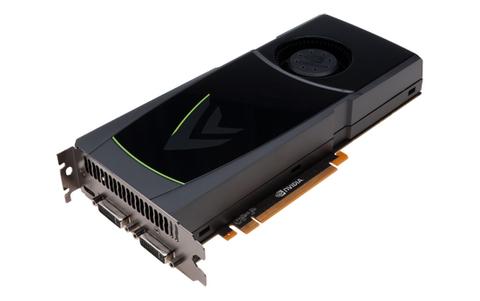
NVIDIA announced a new graphics card to complement the latest generation of the manufacturer. The new GeForce GTX 465 is as its name implies the third and most affordable DirectX 11 cards of the firm of Santa Clara.
The NVIDIA GeForce GTX 465 reference is structured to turn around a GF100 GPUs based on a manufacturing process to 40 nm, clocked at 607 MHz in (just like the GTX 470 and 700 MHz against the GTX 480 ) and provided 352 units of computation, also called CUDA cores, clocked at 1215 MHz (against 448 to the same frequency for the GTX 470 and 480 MHz for the 1401 GTX 480). She also embarks 1GB of GDDR5 memory running at 1603 MHz on a bus with a width of 256 bits (cons respectively 1.25 and 1.5 GB, 1674 and 1848 MHz, 320 and 384 bits for the GTX GTX 470 and 480). It finally shows a TDP of 200 Watts (cons 215 and 250 watts for its predecessors).

One finds also support SLI, allowing to use multiple graphics cards in parallel, CUDA, which relieves the CPU of certain tasks in parallel, acceleration hardware PhysX physics engine and 3D Surround Vision, which offers display in relief on several screens. The map is broken down by a cooling system occupying two slots, requires a power supply with two PCI Express offers two dual-link DVI outputs and a mini HDMI output.


Initial tests of several American colleagues show that, depending on videogames and their settings, the performance of the GeForce GTX 465 evolve into those of an ATI Radeon HD 5830 and a 5870.

The NVIDIA GeForce GTX 465 reference is already available to manufacturers, who will announce their own versions in lockstep, for a suggested retail price of 280 dollars (about 270 euros including VAT).

Monday, May 31, 2010

GeForce 257.15 beta drivers no longer block PhysX on ATI

Paradigm shift or just temporary forgetfulness? Several sites are the echo of a change in the level of beta 257.15 drivers released this week by NVIDIA. These would replace because of the possibility of using a GeForce to perform PhysX calculations since a graphics card brand competitor, AMD, is present in the machine.

Recall that initially was a PhysX technology developed by Ageia, which was the subject of expansion cards dedicated operating whatever the manufacturer of the graphics card used at his side.

A few months after buying Ageia, NVIDIA has terminated this independence by restricting from pilots GeForce 186, the possibility of using a Radeon PhysX therefore was present, even if it were a simple integrated graphics controller. The news was so aroused some discontent among the players.

On ngohq.com, a user called Regeneration states have managed to restore this functionality by using the beta 257.15 drivers of the future, which confirms the German site TweakPC, video support. It remains to see if it is a simple hitch due to the temporary nature of this test version, or if NVIDIA has decided to change tack.

Wednesday, May 19, 2010

BFG graphics cards stop

Exclusive partner of NVIDIA in this area, the American BFG Tech has announced its withdrawal from the market of graphics cards. The manufacturer guarantees its customers that after-sales service will be provided on products already marketed. Other product lines developed by the brand power supplies and laptop computers, will be maintained.

"After eight years ago to provide innovative graphics and quality to the market, we regret to say that this product is no longer profitable for us," said in a statement John Slevin, president of BFG Technologies.

BFG, which graphics cards were only distributed in France, has rapidly developed its brand image, particularly among public players, offering customized templates, guarantees a very long time, and some commercial operations rebranded. In late 2008, the brand had such offered free replacement of an AGP graphics card with its equivalent in PCI-Express.

It remains to know the reasons for the failure to return raised by the firm. Frequent delays Fermi architecture, the low availability of chips and the margins provided by NVIDIA partners there are probably not unrelated. The rumor that BFG could switch on the side of AMD cards / ATI - as did XFX early 2009 - had also been mentioned several times in recent weeks.

Tuesday, May 18, 2010

Geforce GTX 470 in single slot for Galaxy

Galaxy, according to its website 4gamer, intends to announce at Computex, which will open its doors in early June in Taiwan, a single slot version of the NVIDIA GeForce GTX 470. The board would adopt a standard feature while providing a significantly reduced footprint, which would facilitate its integration into the boxes or type Barebone make easier the formation of configurations with several graphics cards. A risk, however: the small size of the heatsink fan could justify a much faster, causing noise nuisance to those of the standard versions.

Fully faired, the card have two DVI outputs and an HDMI connector. Although it is difficult to be certain, it appears to adopt a PCB slightly longer than the standard 470 GTX (24 cm), suggesting that the subsidiary of Palit was able to appeal to the GeForce PCBs 480 GTX (27 cm). Then imagine that the Galaxy is also trying to propose a single GTX 480 slot format, there is only one step ... that we will not cross until you have landed in Taipei for Computex!

Wednesday, May 5, 2010

AMD Low-power ATI FirePro RG220 Graphics Card

AMD announced a remote graphics option for IT managers seeking to replace existing desktop workstations with energy-efficient solutions.

The ATI FirePro RG220 graphics card is designed to help IT managers reduce local power and cooling costs per user while limiting the amount of physical hardware at users' desks.

The FirePro RG220 is an integrated graphics card that includes display compression and IP transmission. It compresses dual-display graphic data at the host and outputs it over a regular IP network to a remote thin client device.

"Power consumption restrictions in crowded office buildings cause headaches for IT managers trying to find the right balance between energy efficiency, system performance and IT spend for the work environments they manage," said Janet Matsuda, senior director, Professional Graphics, AMD. "The ATI FirePro RG220 can be part of a secure, easy to manage solution, and is now available to enterprises that need to deploy updates to multiple users simultaneously, while still giving the end user the full PC experience they're accustomed to."


Features of the new ATI FirePro RG220 :
  • Low power consumption: a max power consumption of 35-watts per card.
  • High-Performance, reliable graphics: 512 MB of on-board graphics memory for graphics intensive applications that need to run on two displays at once.
  •  Small form factor: measuring just half the length of a standard PCIe card, the ATI FirePro RG220 fits into smaller systems and only takes up one PCIe slot within a server.
  • Security: powered by the network, the ATI FirePro RG220 is part of a secure solution that stores user data behind the firewall and within the confines of the data center, helping to ensure that customer or corporate information is protected. Supports compression of information residing in the data center for transmission over regular IP networks to the end user's thin client system.
  • Virtualization: Utilizing Parallels Workstation Extreme (PWE), ATI FirePro RG220 offers a traditional graphics experience in a virtual environment, with the flexibility to also support multiple operating systems at each user's desk. 
Three year limited product repair/replacement warranty .

Saturday, March 6, 2010

Gigabyte Latest developments

Great attention of visitors at the exhibition stand attracted Gigabyte newest video on the decisions of the last generation of Nvidia GeForce GTX 480 and GeForce GTX 470, based on a microarchitecture Fermi. They are based on 40-nanometer graphics chip GF100 and technology support DirectX 11, CUDA, PhysX, and 3D Vision Surround, as well as the tripartite SLI mode (3-way SLI).

The official premiere of the video is scheduled for March 26. Then become aware of their exact specifications and retail prices.

Do not forget to Gigabyte and decisions based graphics systems, AMD. This GV-R587SO-1GD, GV-R577UD-1GD, and GV-R567OC-1GI. The basis of the first two are ATI Radeon HD 5870 and ATI Radeon HD 5770, respectively. Both cards are in the top solution. GV-R567OC-1GI is based on the ATI Radeon HD 5670 and refers to more affordable models.

Another interesting new Hanoverian Gigabyte - netbook new generation of rotary screen T1000P. Had the following characteristics: processor Intel Atom N450, 10,1-inch multitouch screen with a resolution of 1366x768, 2 gigabytes of RAM modules Wi-Fi, 3G and Bluetooth.

In addition, Gigabyte showed two netbook new generation. This M1000 and Q1000C. The basis is the first of the powerful processor Intel Atom N470 with a frequency of 1.83 gigahertz, diagonal computer screen is 10 inches. Gigabyte Q1000C is a budget solution with an Intel Atom N450. Outwardly, the two computers are similar. It is expected that they will appear in stores soon.

Thursday, February 18, 2010

Corsair announced a new case: the Obsidian 700D

With his success with the Obsidian 800D, Corsair continues his adventure in the field of PC enclosures with a new reference: the Obsidian 700D. Declination of the 800D that we were testing it recently (see our Obsidian 800D, the first housing Corsair), the 700D takes in the line and the overall aesthetic with a facade resembling black square. First difference with Obsidian 800D, 700D model swapped its hard drive bay that can connect to hot to fixed locations not accessible from the front.


The total number of pitches 3 1 / 2 inches remains identical with 6 slots for hard drives and five locations of 5.25 inches. Keeping the same dimensions and characteristics that Obsidian 800D, the 700D model, however, loses the glass panel of top model. We find instead a full-size metal panel. With a warranty of two years, Obsidian 700D has not yet recommended retail price. Some sources suggest a price of around € 199 including taxes for availability in the month of April.

Saturday, January 30, 2010

ASUS Unveils Low Radiation Motherboards

ASUS launched the ASUS Protect 3.0 Design based motherboards, which are equipped with an anti-radiation shielding that lowers the generation and transmission of harmful radiation by up to 50%.

The low levels of radiation lowers the adverse health impact to users and delivers more stable system operations. Additionally, active anti-surge protection helps enhance component and system longevity. Protect 3.0 also includes the ASUS EPU (Energy Processing Unit) chip to reduce system-wide power consumption by up to 80.23% and to ensure a more environmentally sustainable operation.

On average, users are exposed to about eight hours of electromagnetic radiation daily from computer usage. Protect 3.0 effectively reduces this radiation exposure by up to 50%?achieving the lowest radiation emission levels in the industry. Additionally, a Low Radiation Circuit Design reduces the radiation produced by electrical components by intelligently positioning oppositely-charged electrical flows across each other to cancel out the fields generated. Finally, a Radiation Moat Design eliminates radiation leakage to surrounding components by confining it to small region around an active area.

With its Anti-Surge Design, Protect 3.0 detects under- or overvoltage conditions in components and prevents electrical surges from spreading. Whenever surges occur especially during a thunderstorm or periods of unstable grid power delivery, Anti-Surge will immediately shut off the electrical supply and prevent potential component damage?thus enhancing total system longevity.

For enhanced efficiency and more earth-friendly operations, Protect 3.0 includes the ASUS EPU (Energy Processing Unit), an energy-saving chip that intelligently reduces power consumption
by up to 80.23%. EPU automatically fine-tunes the power channeled to components such as the CPU in real time for superb efficiency. To further reduce energy consumption, EPU also automatically delivers the most appropriate power via intelligent acceleration and overclocking. Such enhanced efficiency results in less CO2 released to the atmosphere from lower power generation. In fact, 10 million EPU-enabled motherboards can help eliminate up to 207,430 tons of CO2?equivalent to Australia's annual carbon emissions.

Friday, January 29, 2010

Intel retains 80.5% of the market for x86 processors

Crisis or no crisis, the x86 processor market is booming, if one believes the figures released by IDC for the last quarter of the year. After several periods of famine, he would sign even a return to "normal seasonal" with an increase of 31.3% over one year. On the full year, the market rose 2.5% in volume, but lost 7.1% in value, representing a total turnover of 28.6 billion dollars.

"For the third quarter, the modest increase recorded in the fourth quarter indicates that the market recovers its normal seasonal variations," said Shane Rau, an analyst in charge of semiconductors at IDC. "The significant increase over fourth quarter 2008 shows that the market has exceeded the recession."

Intel is still very far ahead, with 80.5% of deliveries made in the last quarter of 2009. AMD followed with 19.4%, an increase of 0.7% over the previous quarter, while VIA represents 0.2% of deliveries.

In the market called "mobile x86 processors for notebooks, Intel's shares rise to 86.8%, against 12.8% for AMD. The server side, the advance is more marked, with 89.9% to 10.1% against Intel for AMD. It is on the market of processors for desktop and workstations as the challenger proved the most aggressive. Over the period studied, it would have made 28.8% of shipments, up 2.3%, against 71% for Intel.

The battle could intensify during 2010, boosted by encouraging prospects. IDC states and expect an increase of about 15% over the year. To establish his leadership, Intel will rely on its latest range of processors to 32 nanometers engraved and fitted with integrated graphics controller. Pending the arrival of its first six-core chip, scheduled for the second quarter (II X6 Phenom), AMD is projected to expand its product lines, focusing on entry and mid-range segments in which the offer is likely to rival that of Intel.